
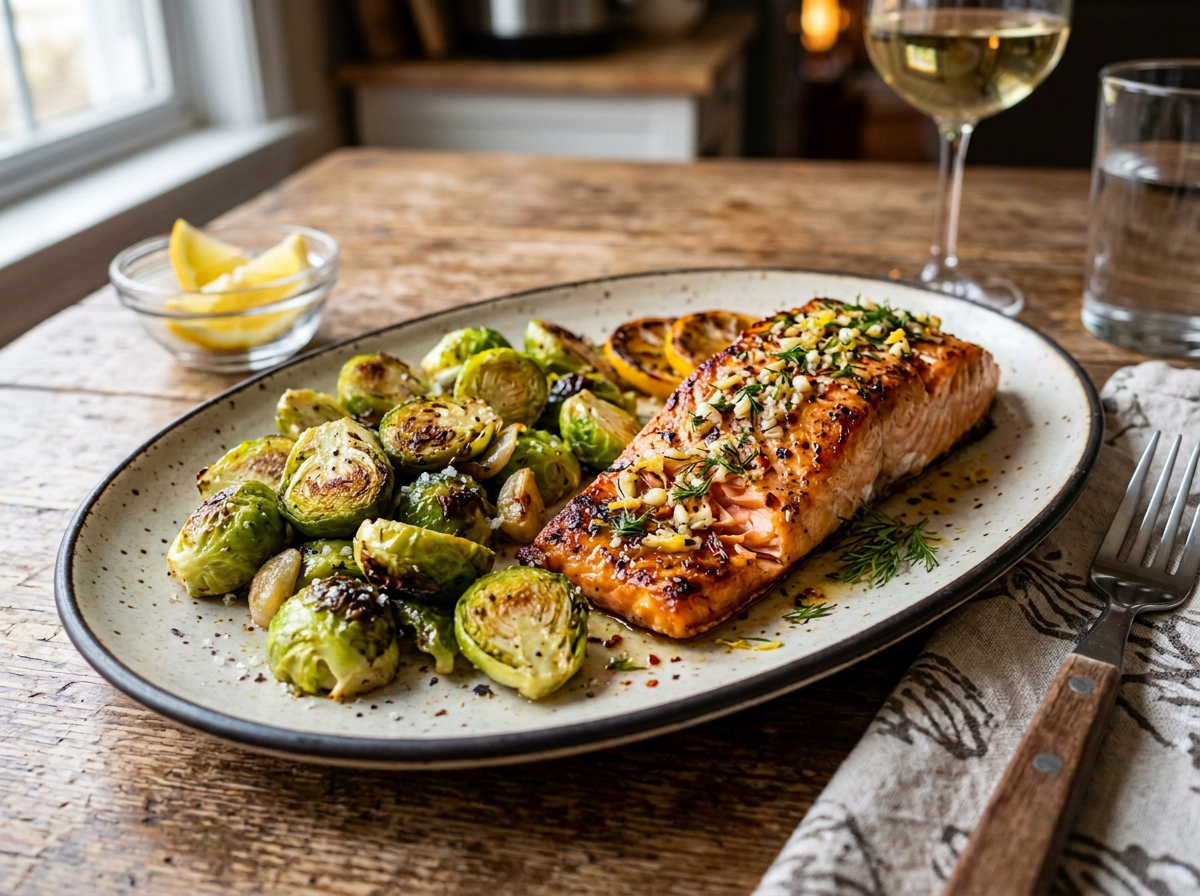
There’s a particular kind of dinner magic that happens when you combine one pan, a hot oven, and ingredients that know how to play well together. This Brussels sprouts and salmon dinner is exactly that kind of meal — the sort of thing that looks and tastes like you spent real effort in the kitchen, when in reality your oven did most of the work while you set the table, poured a glass of wine, and caught your breath after a long day.
PrintOne Pan Baked Brussels Sprouts and Salmon
A simple, flavorful one-pan dinner featuring roasted salmon steaks and Brussels sprouts, finished with a garlicky olive oil, oregano, and white wine marinade.
- Prep Time: 15 minutes
- Cook Time: 25 – 30 minutes
- Total Time: 40 – 45 minutes
- Yield: 6 servings
Ingredients
- 1.5 pounds Brussels sprouts, halved
- 6 salmon steaks
- 6 – 12 whole garlic cloves, peeled (per preference)
For Marinade:
- 1/3 cup olive oil
- 2 additional garlic cloves, minced
- 1 teaspoons dried oregano
- 1 teaspoons salt
- 1/2 teaspoons black pepper
- 3/4 cup white wine
Instructions
Preheat oven and prep pan: Preheat oven to 450°F (230°C). Parchment paper line or lightly grease a large pan that is oven-safe and is 2 or 3 inches deep and measures approximately 9×13 inches to 10×15 inches. Note that a sheet pan is likely too shallow to use for this recipe, due to the amount of marinade added.
Combine the marinade base: In a bowl, whisk together the olive oil, the 2 garlic cloves, minced, dried oregano, salt, and black pepper to make the marinade base (the wine gets added later).
Arrange the Brussels sprouts, halved, and the whole peeled garlic cloves in the pan in a single layer. Pour about 3 tablespoons of the marinade base (without the white wine) over the sprouts and garlic, tossing or stirring gently to lightly coat. Do not add salmon steaks yet – the sprouts and garlic will first be roasted alone in the marinade you have already drizzled.
Roast the Brussels sprouts and garlic alone for 15 minutes, until they start to soften and brown at the edges.
Add white wine to the remaining marinade.
Remove the pan from the oven, gently stir the partially roasted brussels sprouts/garlic mixture, and nestle the 6 salmon steaks in among the Brussels sprouts. then pour the remaining marinade (with the wine) evenly over the salmon and sprouts. Sprinkle some additional dried oregano, salt, and pepper over the salmon and sprouts, to taste.
Return the pan to the 450°F (230°C) oven and continue roasting for 10 – 12 minutes, until the salmon is opaque and flakes easily with a fork. Important: Very thick salmon steaks may require more time than 10 – 12 minutes.
Remove from the oven and let rest for 3 minutes before serving. Serve warm, straight from the pan.
Notes
Serving suggestions: Serve with a wedge of lemon, and pair with crusty bread, rice, or buttered roasted baby potatoes to round out the meal. A simple green salad also works well alongside.
Wine note: Use a dry white wine you’d also enjoy drinking, such as Sauvignon Blanc or Pinot Grigio — it adds brightness to the marinade and helps keep the salmon moist as it finishes roasting.
Storage: Leftovers keep in an airtight container in the fridge for up to 2 days. Reheat gently in the oven or a skillet rather than the microwave to keep the salmon from overcooking.
Why This Recipe Works
The secret to this dish isn’t in the ingredient list — olive oil, garlic, oregano, a little salt and pepper, a splash of white wine. Those are pantry staples most of us already have on hand. The real magic is in the timing.
Instead of tossing everything into the pan at once and hoping it all finishes cooking together, this recipe stages the process. The Brussels sprouts and whole garlic cloves go in first, getting a solid head start in a screaming-hot 450°F oven. By the time the salmon steaks join the party, the sprouts have already begun to soften and caramelize at the edges — that slightly blistered, nutty char that makes roasted Brussels sprouts so much more appealing than their boiled, mushy reputation might suggest.
Only then does the salmon get nestled in among the vegetables, along with the rest of the marinade and a generous pour of white wine. That staggered approach means neither component overcooks while waiting for the other, and the wine added at this later stage does double duty: it deglazes the hot pan into a light, savory sauce, and it keeps the salmon moist as it finishes roasting.
It’s a small technique, but it’s the difference between a dinner where the vegetables are an afterthought and one where every element on the plate earns its place — and it’s all accomplished without a single extra dish to wash.
The Case for Salmon Steaks
Most home cooks are used to salmon fillets — the boneless, skin-on cuts you’ll find shrink-wrapped at the grocery store. Salmon steaks are a different animal, cut crosswise through the whole fish rather than lengthwise along the fillet, which means they often include a bit of backbone running through the center.
That bone isn’t a flaw; it’s a feature. Cooking meat and fish on the bone tends to produce a moister, more flavorful result, since the bone conducts heat differently than the surrounding flesh and helps insulate the meat closest to it. Salmon steaks also tend to hold their shape beautifully under high heat, which makes them a natural fit for a hot, fast oven roast like this one.
If your fish counter doesn’t carry salmon steaks, don’t worry — this dish will still work with thick-cut fillets. Just keep an eye on cook time, since fillets typically cook a bit faster than steaks of similar weight.
A Marinade That Builds in Layers
Rather than mixing one marinade and using it all at once, this recipe splits it into two applications, and that choice matters more than it might seem. The first half — just olive oil, minced garlic, oregano, salt, and pepper — gets tossed with the raw Brussels sprouts before they go into the oven alone. As they roast, that oil-based mixture helps the sprouts crisp and brown rather than steam, which is the whole point of roasting vegetables at high heat in the first place.
The second half of the marinade doesn’t get poured on until the salmon arrives, and that’s when the white wine gets stirred in. Adding wine earlier — say, at the very start — would mean it spends 15 minutes evaporating and reducing before the salmon ever hits the pan, losing much of the bright acidity that makes it worth adding in the first place. Saved for the second half of cooking, the wine has just enough time to loosen the drippings at the bottom of the pan and mingle with the garlic and herbs into something like a light pan sauce, without disappearing entirely into steam.
It’s a good reminder that a marinade doesn’t have to be a single event. Splitting it across stages of cooking lets you control texture and flavor with more precision than dumping everything on at once.
Whole Garlic Cloves: The Quiet Star
It’s easy to overlook the whole garlic cloves in this recipe, since the ingredient list also calls for minced garlic in the marinade. But the whole cloves that roast alongside the Brussels sprouts are doing something different, and arguably better.
Left whole and roasted hot and relatively fast alongside the vegetables, garlic cloves lose their sharp, pungent bite and turn soft, sweet, and almost spreadable — closer to roasted garlic you’d smear on bread than the assertive raw cloves you’d mince into a marinade. Tucked in among the sprouts for the full cooking time, they pick up all the oil and herbs in the pan and become little bonus bites that people always seem to fight over at the table. Don’t skip them, and don’t be shy about eating them whole.
Serving It Up
This dish is hearty enough to stand on its own, but a little something on the side rounds it out nicely. A squeeze of fresh lemon over the top just before serving brightens everything up and cuts through the richness of the salmon and olive oil. From there, crusty bread is an easy, low-effort addition — perfect for soaking up any extra juices left behind. If you want something more substantial, rice or roasted baby potatoes both make excellent bases for the dish, and a simple green salad with a light vinaigrette adds freshness without competing with the main event.
Since white wine is already part of the cooking process, it’s a natural move to serve a glass of the same bottle alongside dinner. A dry, crisp white like Sauvignon Blanc or Pinot Grigio works well both in the pan and in the glass — look for something you’d genuinely enjoy drinking, since a splash of a wine you like will always make a better sauce than one you wouldn’t otherwise pour.
A Few Notes for Success
Because salmon steaks can vary quite a bit in thickness, it’s worth treating the final cook time as a range rather than a fixed number. Thinner steaks may be perfectly done closer to the five-minute mark after joining the sprouts, while thicker cuts — especially those closer to an inch and a half — may need closer to ten to twelve minutes. The most reliable way to know for sure is to check for an internal temperature of about 145°F at the thickest part, and to look for flesh that flakes easily with a fork. Cooking to that visual and textural cue, rather than the clock alone, will serve you far better than a strict timer ever could.
If you end up with leftovers, they’ll keep in an airtight container in the fridge for up to two days. When it’s time to reheat, resist the microwave — a quick warm-up in the oven or a skillet will keep the salmon from turning rubbery and help the Brussels sprouts hold onto some of their roasted crispness.
A Simple Dinner Worth Repeating
What makes this recipe worth returning to isn’t complexity — it’s the way a few thoughtful choices (staggered roasting, a marinade added in stages, whole cloves of garlic left to their own devices) turn simple ingredients into a dinner that feels considered without demanding much hands-on effort. And with everything cooking together in a single pan, cleanup is as easy as the cooking itself. It’s the kind of meal that earns a permanent spot in a weeknight rotation, and one that’s just as suited to a casual dinner with friends.